
Contents
- Zero: About Me
- 0.1 Personal Information
- 0.2 Summer Camp Results
- 0.3 Pre-Admission Recommendation Results
- 0.4 Final Destination
- One: Recommendation-Based Graduate Admission Process
- 1.1 Summer Camps
- 1.2 Pre-Admission Recommendation
- 1.3 September Recommendation Round
- Two: How to Prepare
- 2.1 Choosing Universities and Assessing Your Position
- 2.2 Application Materials
- 2.3 About Interviews
- 2.3 Contacting Professors
- Three: Lessons from My Experience
- 3.1 Choosing an Advisor
- 3.2 Application Strategies for Summer Camps and Pre-Admission Recommendation
- 3.3 Obtaining Information
- Four: A Digression
Zero: About Me
0.1 Personal Information
Major in Mechatronic Engineering, GPA 3.95/4, ranked 1/133 in my major, no research achievements, 11 provincial-level or higher competitions, one patent, and one software copyright
0.2 Summer Camp Results
Accepted into the camp and passed: School of Mechatronics Engineering, Harbin Institute of Technology; Shenyang Institute of Automation; Dalian University of Technology; School of Engineering Science, University of Science and Technology of China
Accepted into the camp but did not pass: School of Mechanical Engineering, Shanghai Jiao Tong University; School of Mechanical Engineering, Tianjin University (conflicted with final exams); School of Mechanical Science and Engineering, Huazhong University of Science and Technology
Not accepted into the camp: School of Mechanical Engineering, Zhejiang University; School of Mechanical Science and Engineering, Huazhong University of Science and Technology; Division of Advanced Manufacturing, Tsinghua Shenzhen International Graduate School; Institute of Automation, Chinese Academy of Sciences; School of Mechatronics Engineering, Beijing Institute of Technology; School of Mechanical Engineering, Xi’an Jiaotong University; School of Mechanical Engineering and Automation, Harbin Institute of Technology, Shenzhen
0.3 Pre-Admission Recommendation Results
Accepted and passed: School of Mechanical Engineering, Tianjin University
Accepted but did not pass: None
Not accepted: School of Mechanical Engineering, Shanghai Jiao Tong University; College of Control Science and Engineering, Zhejiang University; Institute of Automation, Chinese Academy of Sciences; School of Mechanical Engineering, Xi’an Jiaotong University; School of Automation Science and Electrical Engineering, Beihang University
0.4 Final Destination
Robotics Institute, School of Mechatronics Engineering, Harbin Institute of Technology
One: Recommendation-Based Graduate Admission Process
Recommendation-based graduate admission can be roughly divided into three stages: summer camps, pre-admission recommendation, and the September recommendation round. From May (5) to July (7), universities select one round of Outstanding Campers through their summer camps. During August through September (8月-9月), they issue another round of tentative admission offers through pre-admission recommendation. Then, when the graduate application system opens on September (9) 28, there are still opportunities to pick up unfilled places.
1.1 Summer Camps
Summer camps are generally the earliest round of interviews. They usually include some online or in-person talks to introduce the university and school, followed by the crucial interview. Once the interview is over, the summer camp is finished. If you pass the summer camp interview and receive the title of “Outstanding Camper,” it means that you will be admitted as long as you list that university as your choice after the application system opens on September (9) 28. Of course, there are some exceptions, which I will discuss later.
① How to Apply for Summer Camps
Summer camp applications begin in May (5) and continue through July (7). Most schools accept applications around June (6) and hold interviews around July. During this period, you need to check university websites, school websites, graduate admissions office websites, and WeChat official accounts to keep up with announcements from different universities. Most schools have only a 1-2-week application window, and if you miss one, you will not be able to apply.
② Summer Camp Application Strategy
It is relatively more difficult to pass the summer camp stage, and some schools hold their camps in person, which may take 3-4 days. Even so, I recommend applying to as many schools as possible, including several reach, target, and safety schools. I applied to more than ten, nearly 20 schools at the time, and only a handful passed me through the initial document review. Also, attend every interview you can. This gives you more opportunities and helps you gain interview experience.
1.2 Pre-Admission Recommendation
After the summer camps end, the next chance to interview with universities is the pre-admission recommendation stage. If you did not receive a good offer during the summer camps, you can still apply to the same university during this stage. It is relatively easier to pass, so you have a better chance of reaching a stronger university.
① How to Apply for Pre-Admission Recommendation
Applications for pre-admission recommendation are generally open from August through early September (8月-9月). Again, check official sources such as university and school websites, graduate admissions websites, and WeChat official accounts for announcements.
② Pre-Admission Recommendation Application Strategy
These interviews are generally held in early September (9). At this point, I recommend using your summer camp results to choose some reach schools. Some schools may require very troublesome application materials, but try to apply anyway. It is fine if you do not pass; just try not to leave yourself with regrets.
1.3 September Recommendation Round
The September recommendation round generally refers to applying to universities through the national graduate application system on September (9) 28. In theory, you can still apply to a university at that point and be invited to an interview. However, good universities have usually already recruited enough students through summer camps and pre-admission recommendation. Only schools with less popular research directions may receive too few applications and still have openings after the system goes live. That is too risky. Usually, you first receive an offer during a summer camp or pre-admission recommendation, then list that university in the system, and the university’s faculty confirms it to complete the process.
That is the overall process, which runs from May (5) through the end of September (9).
Two: How to Prepare
2.1 Choosing Universities and Assessing Your Position
When choosing a university, the main factors to consider are the school’s strength, its overall research directions, and its location.
To assess a school’s strength, look at whether it received an A+, A, or A- in the fourth round of national discipline evaluations.
To understand a school’s overall research directions, visit its website. The site will introduce some of the school’s research achievements, or you can open several faculty profiles to see what most professors are working on.
As for location, you need to choose based on your plans for the future.
The specific universities you should apply to will differ from person to person. You need to consider your future direction as well as your overall competitiveness, and you can refer to the outcomes of students from your major in previous years.
2.2 Application Materials
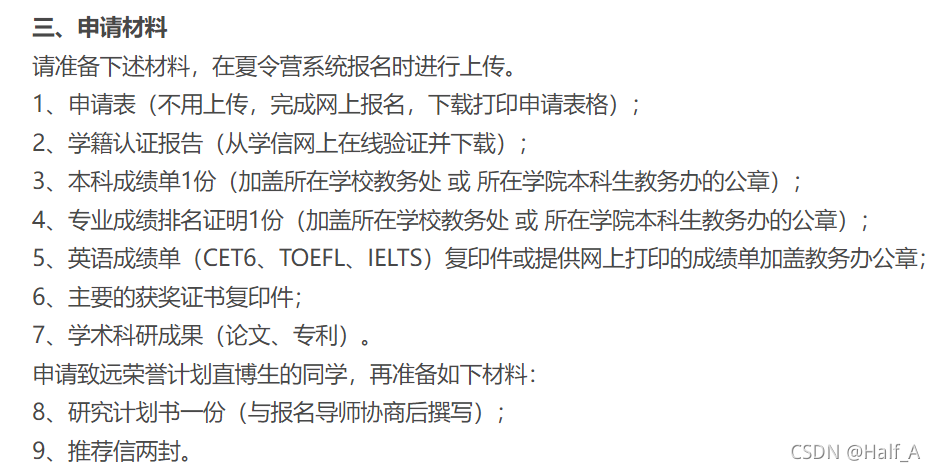
Although recommendation-based graduate admission requires many application materials, each university asks for roughly the same things. Once you have completed your first application, the later ones are very similar. Prepare the necessary materials as early as possible, and keep revising them as you learn more about the process and gain interview experience. You can find the required materials in almost any university’s summer camp or pre-admission recommendation announcement. The image below shows the summer camp application requirements from one university.
Materials worth preparing in advance include a résumé, a personal statement of around 1000 Chinese characters, and recommendation letters. Some schools also require a PPT for online interviews.
2.3 About Interviews
I attended interviews at many different universities, large and small. In summary, the basic interview process begins with a self-introduction. You may then be asked a few questions in English to assess your English ability, such as questions about your research interests or a request to introduce your undergraduate university. Next, the interviewers ask questions based on your résumé and self-introduction. Most questions concern your projects, while relatively few are about coursework in your major. Finally, they may simply chat with you about topics such as what interests you, which universities you applied to, and whether you have contacted any professors.
It is best to prepare a self-introduction of about 2 minutes in advance and practice it until you are thoroughly familiar with it. Review your projects carefully as well, so that you can answer questions about every detail. Also prepare for some common questions, such as what research direction interests you. I have listed some interview questions that I encountered for reference only.
2.3 Contacting Professors
I strongly recommend contacting professors in advance, especially at universities you particularly want to attend. It is best to reach out early because if you do not, the professor may have no places left. The most extreme case I encountered was a professor at Shanghai Jiao Tong University whose places were already filled in June. Although that is very rare, the stronger the professor, the greater the competition for available places. I recommend making contact early by email, and remember to use your university email address.
Three: Lessons from My Experience
3.1 Choosing an Advisor
You can find all information about advisors on the faculty page of the school’s website.
-
The type of advisor: an academically distinguished professor or a promising young professor working hard to advance. Different advisors may determine what your life as a graduate student will be like.
-
The advisor’s research direction: read the biography on the professor’s homepage, the projects they have completed, and their recent papers.
-
The advisor’s character: search online advisor review sites and ask senior students who have studied there. There are many channels. Although this may seem unrelated to research, it actually has a major impact.
3.2 Application Strategies for Summer Camps and Pre-Admission Recommendation
Based on the experiences of students in the previous cohort, pre-admission recommendation gives you a better chance than summer camps of reaching a top university. In other words, participate in as many summer camps as possible, both to gain interview experience and, more importantly, to secure at least one safety offer. Then, during pre-admission recommendation, you can focus primarily on universities that are better than your safety offer, which puts you in a stronger position.
3.3 Obtaining Information
① Official channels: University websites, school websites, and the university. Note that these three websites are different. Some universities publish recommendation-based admission information on all of them, but some post announcements only on the school website, while others post them only on the graduate admissions website. When applying, it is best to check all these websites. Do not assume that a university has not announced anything when it actually has and you simply did not see it.
① WeChat official accounts: Baoyan, Baoyanren, Baoyanquan, Yuyanjia, and others. These accounts periodically post the latest recommendation-based admission news, such as an xxx university announcing summer camp applications, followed by a long list of links. They also share a great deal of advice and experience related to recommendation-based admission.
Four: A Digression
In the end, I still want to say something about personal planning, because during the recommendation-based graduate admission process, you will inevitably face many choices, including your field of study, whether to pursue a master’s or a PhD, your advisor, your university, and your city.
All these choices ultimately come down to how you plan your future. Do you want to pursue a master’s and then a PhD to conduct research, complete a master’s and work for a company, complete a master’s and take the examination for a selected-graduate civil service position, start your own business, or follow another path?
These different personal plans correspond to different choices. Once you have determined your path, however, these seemingly difficult decisions will no longer feel so difficult. Some people may say that they do not yet know which path they want to follow and would rather take things one step at a time. I believe, however, that determining your path in life as early as possible and beginning to work toward it sooner is most worthwhile. If you finish graduate school only to discover that what you want to do is completely different from what you have been doing, it will be too late for regrets because you will already have paid an enormous cost in time.
Comments